Editorial update: August 21, 2026. Numeric benchmark snapshots were last reviewed on June 8, 2026; source reachability, model-page freshness, and the DeepSeek technical report were rechecked on August 21. Verify live leaderboards before making a purchase or migration decision.
If you searched for LLM benchmark scores 2026 coding math reasoning comparison, the short version is this: match the benchmark to the task before choosing a model, then verify the source date, scaffold, and success metric.
Coding bug fixes, algorithm contests, math reasoning, and terminal-agent workflows are no longer measured by the same scoreboard. GPT-5.5, Claude Opus 5, Gemini 3.1 Pro, and DeepSeek V3.2 all appear in different source contexts. The useful move is to compare the right benchmark for the job.
Which LLM Benchmark Should You Use?
Use SWE-bench for real repository repair, Aider Polyglot for code-edit quality, LiveCodeBench for algorithmic coding, and Terminal-Bench for shell-heavy agent work. No single benchmark proves that a model is best for every development workflow, so choose the test that most closely matches the task your team will actually run.
| If you need to evaluate | Start with | Then verify |
|---|---|---|
| Repo bug fixes and patches | SWE-bench Verified | Scaffold, test policy, and tool permissions |
| Multi-file editing in an IDE | Aider Polyglot | Cost, diff quality, and review burden |
| Algorithms and fresh coding problems | LiveCodeBench | Contamination controls and task difficulty |
| Autonomous terminal work | Terminal-Bench | Sandbox, retries, and human approval gates |
LLM Coding Benchmarks 2026: Quick Map
The phrase LLM coding benchmarks covers several different tests. SWE-bench measures real repo bug fixing, Aider measures multi-language edit quality, LiveCodeBench measures programming challenge performance, and Terminal-Bench measures command-line agent execution.
That is why a useful LLM coding benchmark 2026 comparison should not collapse everything into one score. Match the benchmark to your workflow first, then compare GPT, Claude, Gemini, DeepSeek, and open-model results inside that context.
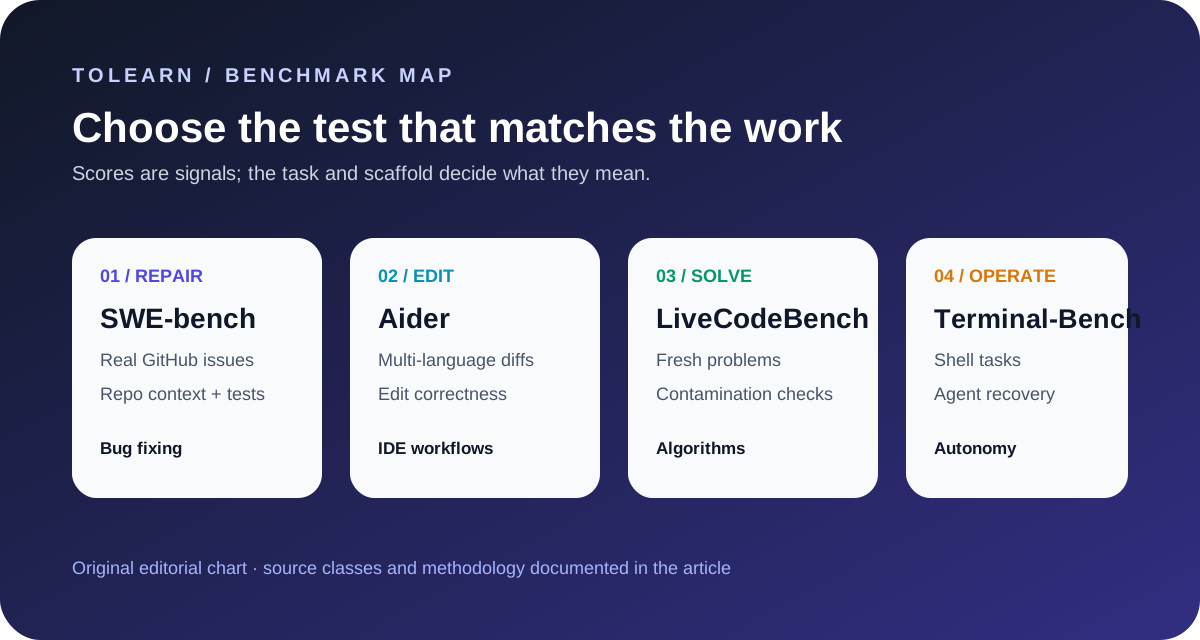
Original chart: ToLearn's editorial mapping of benchmark families to the workflows they actually measure.
Current LLM Benchmark Scores 2026
This snapshot separates public leaderboards from vendor-reported release metrics. That distinction matters: a raw model, a coding agent, and an IDE assistant can post very different scores even when they use the same underlying model.
| Model or leaderboard entry | Coding score | Math / reasoning score | Best readout | Source | Source type |
|---|---|---|---|---|---|
| GPT-5.5 | SWE-Bench Pro: 58.6%; Terminal-Bench 2.0: 82.7% | FrontierMath Tier 1-3: 51.7%; Tier 4: 35.4% | Strongest signal for agentic terminal workflows and hard scientific reasoning in OpenAI's release data | OpenAI GPT-5.5 | Vendor report |
| Claude Opus 5 | Latest Anthropic frontier coding and agent model; no comparable public score recorded in this snapshot | Verify current context and evaluation details on the live model page | Current Anthropic model-page reference; do not treat the qualitative model page as a cross-vendor benchmark score | Anthropic Claude Opus | Vendor/model page |
| Gemini 3.1 Pro | Latest Gemini 3 series model card | Native multimodal reasoning model | Best evaluated as a multimodal reasoning and long-context model; use public coding leaderboards when exact task scores matter | Google DeepMind Gemini 3.1 Pro | Vendor/model card |
| DeepSeek V3.2 | SWE-bench Verified: 70.0% resolved | GPQA Diamond: 82.4%; MMLU-Pro: 85.0% | Strong value-oriented reasoning and coding contender, especially when cost matters | DeepSeek V3.2 model card | Model card |
| Aider Polyglot leaderboard | GPT-5 high: 88.0%; GPT-5 medium: 86.7%; Gemini 2.5 Pro: 83.1%; DeepSeek V3.2 Reasoner: 74.2% | Not a math benchmark | Best for real-world code editing and diff quality | Aider leaderboard | Third-party |
| SWE-bench public snapshot | Verified reports % Resolved over 500 tasks | Not a math benchmark | Best for real GitHub issue repair; current top public entries include Claude-family, Gemini 3, GPT-5.2 Codex, Kimi K2.5, and DeepSeek V3.2 variants | SWE-bench | Third-party |
The headline: GPT-5.5 is the strongest launch-data story for terminal and scientific reasoning; Claude Opus 5 is the newest Anthropic model listed for agentic coding; Gemini 3.1 Pro is the latest Google multimodal reasoning model; DeepSeek V3.2 is the value model to watch. For a broader archive path, see the AI Model Comparisons directory and our AI agent tools comparison for workflow-level choices.
Coding Benchmark Scores
Coding benchmarks split into three useful families:
| Benchmark | What it tests | Best use |
|---|---|---|
| SWE-bench Verified | Real GitHub issues, repo understanding, patches, tests | Bug fixing and production-style coding agents |
| Aider Polyglot | Multi-language code editing and diff correctness | IDE and patch workflows |
| LiveCodeBench | Continuously refreshed competitive programming problems | Algorithmic coding and contamination-resistant problem solving |
| Terminal-Bench | Command-line tasks and agent execution | Shell-heavy autonomous workflows |
SWE-bench: Real Repository Repair
SWE-bench remains the most important public benchmark for real bug-fixing ability because it evaluates whether a system can resolve actual repository issues. The public leaderboard reports % Resolved, not a generic "coding IQ" score.
That distinction matters. A high SWE-bench entry often reflects both the model and the scaffold around it: retrieval, file editing, tool calls, test execution, retry policy, and patch validation. This is why Claude-family models, Gemini 3 entries, GPT-5.2 Codex entries, Kimi K2.5, and DeepSeek variants can all appear in the same public ecosystem without producing a simple model-only ranking.
If your workflow is close to "fix this real bug in this repo," SWE-bench is the right starting point. If your workflow is "edit this file cleanly in my IDE," Aider is often more useful.
Aider Polyglot: Editing Quality
The Aider leaderboard is especially useful because it tests whether a model can produce usable edits across programming languages. As of this refresh, the notable rows are:
| Model | Percent correct | Cost in Aider run | What it suggests |
|---|---|---|---|
| GPT-5 high | 88.0% | $29.08 | Best signal for high-accuracy edits in this leaderboard |
| GPT-5 medium | 86.7% | $17.69 | Nearly as strong at lower cost |
| Gemini 2.5 Pro Preview 05-06 | 83.1% | Varies | Strong editing baseline from Google's previous generation |
| DeepSeek V3.2 Reasoner | 74.2% | $1.30 | Strong value-to-cost profile |
This is why I would not read "best coding model" as one universal claim. If you are doing patch-heavy work, GPT-5-style Aider results matter. If you are doing autonomous repo repair, SWE-bench and your agent scaffold matter more.
For hands-on OpenAI workflow tactics, the older but still useful companion piece is GPT-5 for Coding: Benchmarks, Pricing & 5 Pro Tips.
LiveCodeBench: Algorithms and Contamination Resistance
LiveCodeBench is valuable because it continuously adds programming problems, which reduces training-set contamination risk compared with static benchmarks.
In the currently selected public window (August 1, 2024 to May 1, 2025), strong entries include o4-mini high, Gemini 2.5 Pro 06-05, o3 high, DeepSeek-R1-0528, and Qwen3 variants. That does not automatically mean those are the best production coding assistants. It means they are strong at competitive-programming-style generation in that published window.
Use LiveCodeBench when your question is "which model solves algorithmic coding problems?" Use SWE-bench or Aider when your question is "which model can change my codebase correctly?"
Math and Scientific Reasoning Scores
Math and scientific reasoning are now a separate comparison from general coding.
GPT-5.5's release data reports 51.7% on FrontierMath Tier 1-3 and 35.4% on FrontierMath Tier 4, alongside 58.6% on SWE-Bench Pro. Those numbers point to a model optimized for hard, multi-step scientific and agentic work rather than only short-form coding prompts.
DeepSeek V3.2's technical report and model card report 82.4% on GPQA Diamond and 85.0% on MMLU-Pro. The same model-card evidence lists 70.0% resolved on SWE-bench Verified, while the technical report uses a separate internal code-agent framework for its higher internal SWE-Verified result. That makes DeepSeek much harder to dismiss as a budget-only option, but the two evaluation setups must not be merged. Deployment, latency, tool use, and data policy still matter.
Gemini 3.1 Pro should be read as a native multimodal reasoning model from Google's latest Gemini 3 generation. If your math workflow includes diagrams, visual context, long documents, or multimodal inputs, raw text-only leaderboard comparisons will miss part of the picture. The practical companion article here is Gemini Deep Thinking API: Build Math AI Apps.
Agentic and Terminal Workflow Scores
Agentic coding is not the same as autocomplete.
Terminal-Bench, SWE-Bench Pro, and real coding-agent evaluations ask whether a model can keep track of a task, use tools, inspect outputs, recover from errors, and finish useful work. GPT-5.5's 82.7% Terminal-Bench 2.0 number is a strong signal for this category.
Claude Opus 5 is also relevant here because Anthropic's live model page now lists it above the older Opus entries. The page should be treated as a current product reference, not as a substitute for a comparable third-party benchmark row.
This is also where tool choice matters. Cursor, Claude Code, Codex-style terminal agents, and custom scaffolds can change the result. The related question is not only "which model?" but "which model inside which workflow?" For the productivity trap behind this, read AI Coding Tools: 19% Slower Despite Feeling Faster.
What Changed Since February 2026
The February version of this article treated Claude Opus 4.5, GPT-5.2, Gemini 2.5 Pro, and DeepSeek V3.1 as the central comparison set. That is no longer fresh enough for a 2026 benchmark page.
Here is the June 2026 update:
| February framing | June 2026 refresh |
|---|---|
| Claude Opus 4.5 as the premium coding leader | Claude Opus 5 is now listed as the current Anthropic frontier model for coding and agents |
| GPT-5.2 as the main OpenAI reasoning model | GPT-5.5 now anchors the OpenAI comparison for terminal and scientific reasoning benchmarks |
| Gemini 2.5 Pro as the context-window story | Gemini 3.1 Pro is the current Google model-card target; verify Anthropic's live context claim separately |
| DeepSeek V3.1 as the value contender | DeepSeek V3.2 and V3.2-Speciale are now the relevant reasoning/coding references |
| One "best model" claim | Task-specific comparison across SWE-bench, Aider, LiveCodeBench, Terminal-Bench, and math reasoning |
The open-model story also changed. Kimi K2.5, Qwen, GLM, MiniMax, and DeepSeek entries now appear often enough in public leaderboards that they should be treated as real options, not curiosities. The Moonshot angle is covered separately in Verbose AI Beats Fast AI: Moonshot K2 $1,172 Paradox.
Which Model Should You Use?
| Use case | Best starting point | Why |
|---|---|---|
| Real repo bug fixing | Claude-family or Gemini/GPT systems with strong SWE-bench scaffold results | SWE-bench rewards repo understanding, tests, and patch validation |
| Patch-heavy IDE editing | GPT-5 high/medium in Aider-style workflows | Aider emphasizes clean diffs and multi-language editing |
| Terminal-heavy autonomous work | GPT-5.5 or Claude Opus 5 style agent setups | Terminal-Bench and agentic launch positioning matter more than autocomplete |
| Math and scientific reasoning | GPT-5.5, DeepSeek V3.2-Speciale, Gemini 3.1 Pro | Use FrontierMath, GPQA, MMLU-Pro, and multimodal reasoning context together |
| Budget-sensitive coding | DeepSeek V3.2, Kimi K2.5, Qwen/GLM-family options | Public scores are now strong enough to justify serious pilots |
| Large-context professional work | Claude Opus 5 or Gemini 3.1 Pro | Context window and multimodal/document handling can dominate raw coding scores |
For most teams, the best stack is hybrid:
- Use a fast, cheaper model for routine edits and explanations.
- Use a stronger reasoning model for hard bugs, architecture, and multi-step agent runs.
- Validate every model output with tests, review, and observability.
- Re-check benchmark data monthly, because the public leaderboard can change faster than your procurement cycle.
Benchmark Caveats
Methodology and source tiers
Every score on this page is tagged by source class: vendor-reported release data, third-party leaderboard data, or a public benchmark snapshot. Vendor results are useful for understanding the manufacturer's chosen configuration; third-party results are more useful for cross-model context; neither is a guarantee of performance in your repository.
For each row, the review records the model version, dataset or leaderboard date, scaffold, tool access, success metric, and whether the result can be reproduced. The AI benchmark methodology guide contains the full evidence-ledger template and refresh rules. Where a source does not publish a comparable number, the table intentionally uses a qualitative label instead of inventing a score.
Benchmark scores are useful, but they are not buyer's guides by themselves.
Scaffolding changes the score. SWE-bench entries often include a model plus an agent system. Retrieval, file selection, tool execution, retries, and test harnesses can move the result dramatically.
Aider, SWE-bench, and LiveCodeBench measure different work. A model can be excellent at code edits and weaker at real repo bug repair. Another can solve algorithm contests but struggle with messy production code.
Vendor launch scores and public leaderboards should not be merged blindly. Keep them in separate rows unless the task, dataset, and evaluation harness are identical.
Latency and cost are invisible in many summaries. A model that gets a higher score with heavy reasoning may be the wrong choice for real-time IDE use.
Freshness matters. A 2026 benchmark article should name the data-check date. If this page is more than a month old when you read it, verify the latest leaderboard before making a serious model decision.
Bottom Line
The best 2026 LLM benchmark comparison is not "Claude vs GPT vs Gemini vs DeepSeek" as a single fight. It is a map:
- GPT-5.5 looks strongest in OpenAI's June 2026 launch data for terminal-agent and scientific reasoning tasks.
- Claude Opus 5 is the newest Anthropic model listed for coding, agents, and professional work; verify its live evaluation details before comparing it numerically.
- Gemini 3.1 Pro is Google's current multimodal reasoning model-card target.
- DeepSeek V3.2 is the value contender that now deserves serious coding and reasoning pilots.
- Aider, SWE-bench, LiveCodeBench, and Terminal-Bench answer different questions, so use the benchmark that matches your workflow.
If you only remember one rule: choose the benchmark that looks like your actual task, then choose the model.